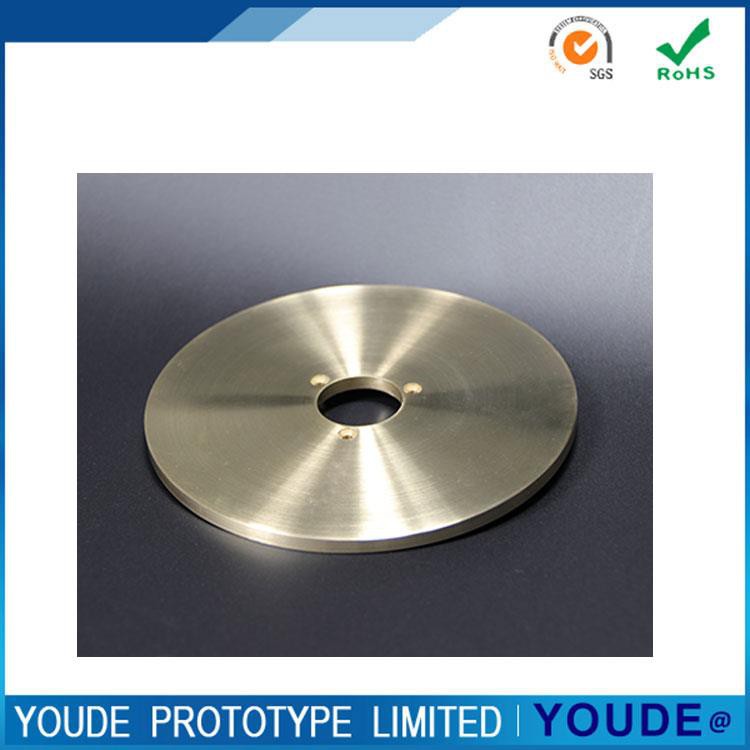

1. Turning machining: making rotating parts with high accuracy
Turning is a very popular CNC machining technology in the automotive sector. It is especially good for making parts that rotate, including shafts and disks. For example, a manufacturer in Taizhou that makes parts for cars has been able to finish external circle, internal hole, and thread processing all at once by using a CNC lathe with a FANUC system. The time it takes to process one piece has gone down from 15 minutes to 6 minutes, the accuracy has gone up to ± 0.02mm, and the yield rate has gone up to 99.2%.
Core technical:
Multi-process integration: CAD/CAM software programming lets you do rough turning, precision turning, groove cutting, thread processing, and other tasks all on one machine. This cuts down on the number of times you have to clamp things and the number of times you have to position things wrong.
Design with high rigidity: employing ball screw pairs and special support bearings to lower the friction in the transmission chain and keep it stable when cutting at high speeds. For instance, one company extended the tool life during the processing of titanium alloy implants from 200 pieces to 800 pieces by changing the configuration of the spindle.
Intelligent parameter control: This system combines a vibration monitoring system with a tool life management system to automatically change the cutting speed (like 2000–3000rpm) and feed rate in real time to keep tools from wearing out and causing dimensional changes.
Common uses:
Crankshaft and camshaft for the engine
Input/output shaft for the transmission
Master cylinder piston for the brake system
2. Milling machining: making complicated surfaces quickly and easily
Milling is the main method used to make automobile cavity parts. It works best on parts with porous and uneven cavity structures, such engine cylinder blocks and gearbox housings. For example, with the motor housing of new energy vehicles, 5-axis CNC equipment can machine the internal curved surface, inclined hole, and sealing groove of the cavity all at once by linking the spindle and worktable. This keeps the coaxiality error to ≤ 0.008mm, which is much better than industry standards.
Technical core:
3-axis, 4-axis, and even 5-axis linkage technology breaks past spatial limits and allows for high-precision machining of complicated surfaces. For instance, one company changed the manufacturing step so that the Ra roughness of the inner wall of the engine cylinder water jacket cavity was less than 0.8 μ m. This made the coolant flow 15% more efficiently.
Strategy for cutting in layers: When cutting thin-walled structures like battery pack cooling chambers, the "low-speed feed+small cutting depth" settings are utilized to lessen the effect of cutting force on the wall surface and make sure that the flatness error is ≤ 0.01mm.
Specialized tool development: tools like diamond tools and hard alloy-coated tools that are made to work with diverse materials like aluminum alloy and cast iron. Ultra-fine grain hard alloy cutting tools, for instance, can cut high-silicon aluminum alloys at speeds of up to 3000 revolutions per minute.
Common uses:
Water jacket chamber for the engine cylinder block and cylinder head
Chamber for the gearbox gears and the shifting mechanism
Cooling channel for the battery pack of a new energy vehicle
3. Boring Processing: Guaranteeing the Accuracy of Hole Series Parts
Boring is an important method for making holes in the automobile sector, especially where high precision and high surface quality are needed. As an example, when machining engine crankshaft holes, the three-step process of "rough boring → semi precision boring → precision boring," along with the constant linear speed cutting function, can get the aperture size accuracy to IT5 level and the cylindricity error to ≤ 0.005mm.
The main technical part:
High stiffness boring bar design: employing static pressure bearing support and a tungsten carbide coating treatment to make machining more accurate by reducing the effects of vibration. For instance, one company improved the boring bar structure so that the Ra value of the surface roughness of aluminum alloy cylinder bodies went from 1.6 μ m to 0.4 μ m.
Smart compensation technology: Real-time correction of tool offset, which is done by combining laser probes with online detection systems, makes sure that the hole system's positioning inaccuracy is ≤ 0.01mm.
Composite machining process: Combining boring with milling, drilling, and other procedures to cut down on the number of times you have to clamp. The "boring milling composite" technique, for instance, has cut the machining cycle for a gearbox housing machining line from 8 hours to 3 hours.
Common uses:
Holes for the engine crankshaft and camshaft
Holes for the transmission input and output shafts
Planetary wheel hole in the differential housing
4. Technology for hole machining: the foundation of functional implementation
Drilling, reaming, and tapping are all parts of hole machining, which is an important part of making car parts. For example, the "drilling expansion hinge" composite method can make the aperture size of the IGBT module cavity in the new energy vehicle electronic control system accurate to H7 level, with a verticality error of ≤ 0.005mm. This meets the high-density heat dissipation criteria.
The technical core:
High-precision drilling system: uses drill bits that are cooled from the inside and high-pressure coolant to make chip removal easier and prevent scratches on the hole walls. For instance, one company changed the drilling parameters so that the hole wall roughness Ra was less than 1.6 μm when machining cast iron cylinder bodies.
New ways to process threads: A "tapping+rolling" composite method is used on aluminum alloy materials to make the threads stronger by more than 20% and cut processing costs by 15%.
Technology for cutting deep holes: Deep hole machining with a hole depth to diameter ratio (L/D) of ≥ 10 can be done with BTA (gun drilling) or spray suction drilling technology. This is necessary for parts like steering system valve bodies.
Common uses:
The main oil circulation hole in the engine cylinder block
Hole for oil to go through the transmission valve body
Hole for the ABS sensor in the brake system