


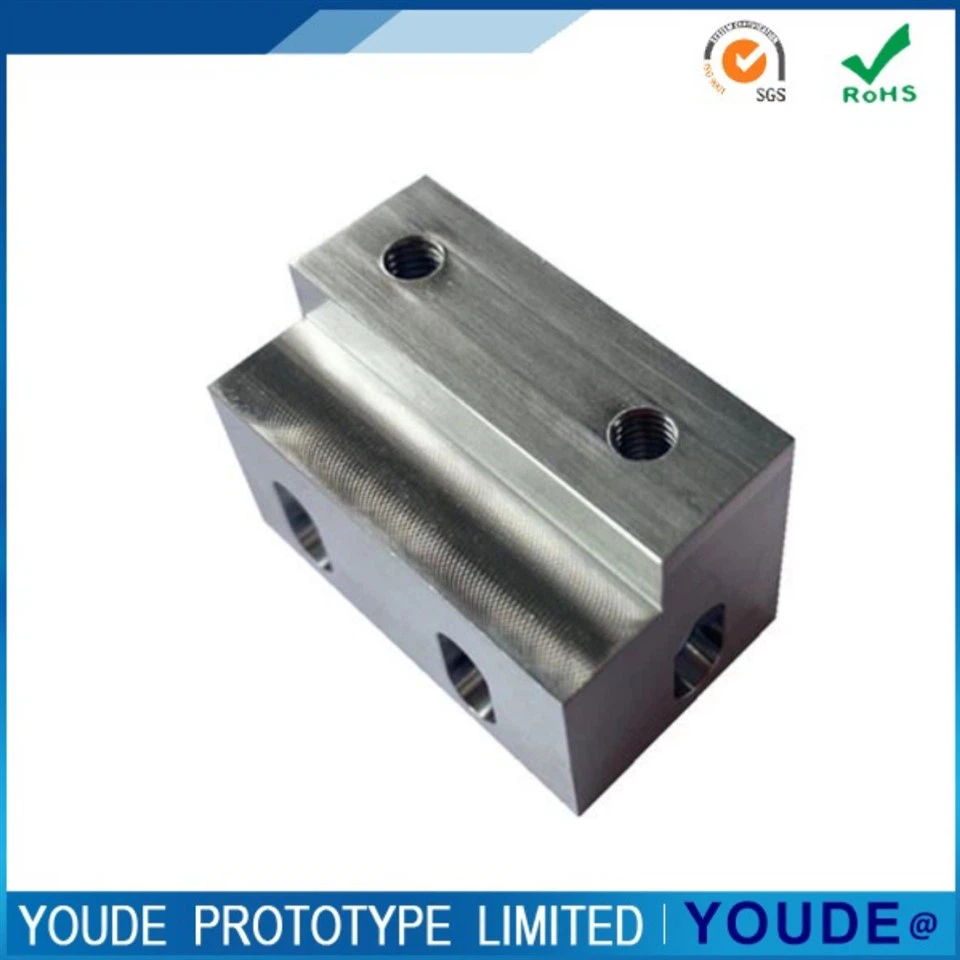
Processed aerospace components
Aerospace parts tend to combine light structures with precise mounting features. How we machine a part depends on its geometry, material and function. These are the part families we handle most often.
Structural Brackets and Mounting Plates
Brackets and mounting plates position and support other assemblies, so hole locations and the relationships between mounting faces matter more than any single dimension. We plan setups to hold those relationships and machine related faces in the same setup where the geometry allows.
Thin-Wall Housings and Enclosures
Thin walls move. Cutting forces, clamping pressure and residual stress in the stock can all pull a wall out of tolerance. Before we cut, we review the workholding, the material removal sequence and how the part will be inspected. We typically rough, relieve stress and then finish, rather than taking a part to final size in one pass.
If your housing has critical wall thicknesses, highlight them on the 3D model and we will flag feasibility issues at the quotation stage.
Titanium Fittings and Connectors
Titanium offers high strength for its weight and good corrosion resistance, but it machines slowly. It holds heat at the cutting edge and wears tools fast, so it needs sharp tooling, stable fixturing and controlled coolant delivery. Our titanium CNC machining covers fittings, connectors and structural parts, including threaded features and sealing surfaces.
Please state the exact alloy (for example Ti-6Al-4V), thread specification and sealing-surface finish on the drawing.
Hydraulic Manifolds and Fluid-System Components
Manifolds depend on accurately positioned ports, intersecting passages and clean sealing surfaces. During quotation we check drilling access, internal passage geometry, thread types and any cleanliness or pressure-test requirements. If you need leak or pressure testing, tell us at the RFQ stage so we can confirm how it will be done and documented.
Precision Housings and Multi-Face Structural Parts
These parts usually carry several mounting faces, pockets, slots and precision bores whose positions relate to each other. We use the datum references and positional tolerances on your drawing to define setups and the inspection plan.
Aerospace Applications
We machine parts for customers in these areas:
Unmanned aerial vehicles (UAVs) and drone structures
Avionics and electronics enclosures
Satellite and space-related hardware
Hydraulic and fluid-control assemblies
Aircraft ground-support equipment
Prototype and test hardware for new programs
Materials for Aerospace CNC Machining
Material choice affects weight, strength, machinability, cost and stability during machining. Please give the exact alloy, temper or condition, and specification on your drawing. "Aluminum" or "titanium" alone is not enough to quote accurately.
|
Material family |
Common grades |
Typical use |
|
Aluminum alloys |
6061-T6, 7075-T6, 2024-T3 |
Brackets, housings, structural parts |
|
Titanium alloys |
Ti-6Al-4V (Grade 5), Ti Grade 2 |
Fittings, connectors, high-strength parts |
|
Stainless steel |
304, 316L, 17-4 PH |
Fittings, fasteners, corrosion-resistant parts |
|
Nickel-based alloys |
Inconel 718 |
High-temperature and high-stress parts |
Aluminum Alloys
6061-T6 is a good general-purpose choice with solid machinability. 7075-T6 gives higher strength for structural parts but needs more attention to corrosion protection and to residual stress in thin sections.
Titanium Alloys
Ti-6Al-4V is the grade we see most often. It needs lower cutting speeds and rigid setups. Lead time and cost run higher than aluminum, so we confirm stock availability early.
Stainless Steel
17-4 PH suits parts that need strength after heat treatment. 316L is chosen where corrosion resistance matters most. State the heat-treat condition on the drawing.
Nickel-Based Alloys
Inconel 718 and similar alloys are tough on tools and generate heat, so we review each project individually for process, tooling and schedule before we quote.
Material Certification and Traceability
If you need mill certificates, heat or lot numbers, or conformance to specific AMS or ASTM specifications, state this in your request for quotation (RFQ). We confirm that the grade, condition and paperwork can be supplied before we accept the order.
CNC Machining Capabilities and Tolerances
3-Axis, 4-Axis and 5-Axis Milling
3-axis milling is efficient for parts with accessible faces and conventional features. 4-axis and 5-axis machines reach more faces in one clamping, which helps with angled surfaces, compound features and parts that would otherwise need several fixtures. Fewer setups also means fewer chances for position error between features.
|
Capability |
Specification |
|
Milling |
3-axis, 4-axis, 5-axis |
|
Max. part size |
[X × Y × Z mm] |
|
Standard tolerance |
±0.01 mm |
|
Tight tolerance |
Down to ±0.005 mm on suitable features, after engineering review |
|
Surface roughness |
[Ra value, as specified] |
|
Inspection equipment |
[CMM model/accuracy, optical measurement] |
Dimensional Tolerances
Our standard machining tolerance is ±0.01 mm. On suitable features, we can hold ±0.005 mm after reviewing the drawing. Whether that is realistic depends on feature size, wall thickness, material, datum strategy and how the feature will be measured. A tolerance that is easy on a small bore may not be practical across a large, thin-walled part.
Surface Finish and Post-Processing
We deburr every part. Other treatments are available depending on the drawing:
Anodizing (for example MIL-A-8625 Type II or Type III on aluminum)
Passivation of stainless steel (for example per AMS 2700)
[Other treatments you offer]
Coating and plating add thickness, so tell us which dimensions apply before or after finishing.
Why Machining Strategy Matters for Aerospace Parts
Aerospace components often combine thin walls, deep cavities, angled faces and tight positional tolerances. How a part is fixtured and sequenced directly affects cycle time, consistency and inspection effort.
Fewer Setups
Each re-clamp is a chance for error. Where the geometry allows, we machine related features in a single setup, or use 4-axis and 5-axis access, to keep positional relationships tight.
Thin-Wall Control
We balance cutting forces, clamping pressure and removal sequence to keep thin sections stable. Where dimensional stability is critical, we agree the measurement conditions with you.
Complex Geometry Review
Deep pockets, narrow slots and steep angles limit tool access and sometimes gauge access. We check the 3D model for these issues first. If a feature can't be machined or inspected as drawn, we raise it during engineering review, before any material is cut.
Inspection and Quality Documentation
We inspect to your drawing, purchase specification and agreed acceptance criteria. Methods include CMM measurement, optical measurement and targeted checks of critical dimensions.
Inspection Requirements
Tell us which features need specific measurement methods or reporting. This matters most for positional tolerances, mating surfaces and precision holes that affect assembly.
First Article Inspection and Material Documents
If you need a First Article Inspection (FAI) report, material certificates or dimensional reports, state this in your RFQ. We confirm the format and availability of each document before accepting the order.
Quality Certifications
Youde Mold holds AS9100 and ISO 9001 certifications. Certificates are available on request, including the certification body and validity dates.
Confidentiality and Export Control
We treat customer drawings and models as confidential and can sign an NDA before you send files. If your project is subject to export-control rules (such as ITAR or EAR), tell us before sharing any technical data so we can confirm whether we can take the work.
From Drawing Review to Delivery
Drawing and model review. Send your 3D CAD model and 2D drawing, with critical dimensions, datums and special requirements marked.
Material and process confirmation. We check the material, process and post-processing against the part design and answer open questions.
Quotation and schedule. Our quotation lists scope, quantity, material, finishing and lead time.
CNC machining. We produce to the approved drawing. If a change would affect acceptance, we review it with you first.
Inspection and documentation. We check the finished parts against the agreed criteria and supply the reports and material documents specified in your order.
Packaging and shipment. We pack for the part's handling needs and ship to the agreed destination and terms.
FAQ
Q: What do you need for an aerospace CNC machining quotation?
A: A 3D CAD model, a 2D drawing, the material specification, quantity and delivery requirements. Add critical tolerances, surface treatments and documentation needs where they apply.
Q: What tolerances can you hold?
A: Our standard tolerance is ±0.01 mm. On suitable features we can reach ±0.005 mm after review of geometry, material, process and inspection method. Mark critical dimensions on the drawing.
Q: Which materials do you machine?
A: Aluminum alloys (such as 6061-T6 and 7075-T6), titanium (such as Ti-6Al-4V), stainless steel (such as 17-4 PH and 316L) and selected nickel-based alloys. We confirm exact grade and condition before production.
Q: Can you machine parts from my CAD files?
A: Yes. We review customer CAD models and drawings for feasibility, achievable tolerances and process suitability before we quote.
Q: What is the typical lead time?
A: It depends on material and requirements. As a guide: [aluminum parts without special finishing: X–X days; titanium, stainless or nickel-based alloys: X–X days; parts requiring anodizing, passivation or full inspection reports: add X–X days]. Your quotation will state a confirmed delivery date.
Hot Tags: cnc milling prototype, prototype cnc milling, cnc milling prototype, cnc milling parts, prototype machining, cnc prototyping, custom metal milling, cnc milling services, aluminum prototype machining, plastic prototype machining, cnc machining parts, cnc machining prototyping, prototype machined parts, CNC Plastic Prototype, plastic prototyping services, cnc prototype manufacturing, CNC Aluminium Prototyping


