


Search "robotics cnc machining" and the top results are mostly robots tending machines, or a robotic arm holding a cutter and milling directly - the robot holding the tool. That is one legitimate meaning. But the other side is what most equipment engineers are actually looking for: manufacturing parts for robots themselves, from the first joint housing prototype to the 10,000th production unit. That's what this article covers - the part-making side of robotics cnc machining, arranged the way you'd actually make the decisions: materials, tolerances, process, finishing, then scale-up.
Let's get the scope straight first. Robotics cnc machining here means robot part production - machining the structural and drive components of a robot - not a machine-tending work cell. The technical questions are completely different on the two sides. One side asks how to grip a workpiece more reliably; the other asks what bearing-seat tolerance keeps a joint from trembling through its whole life.
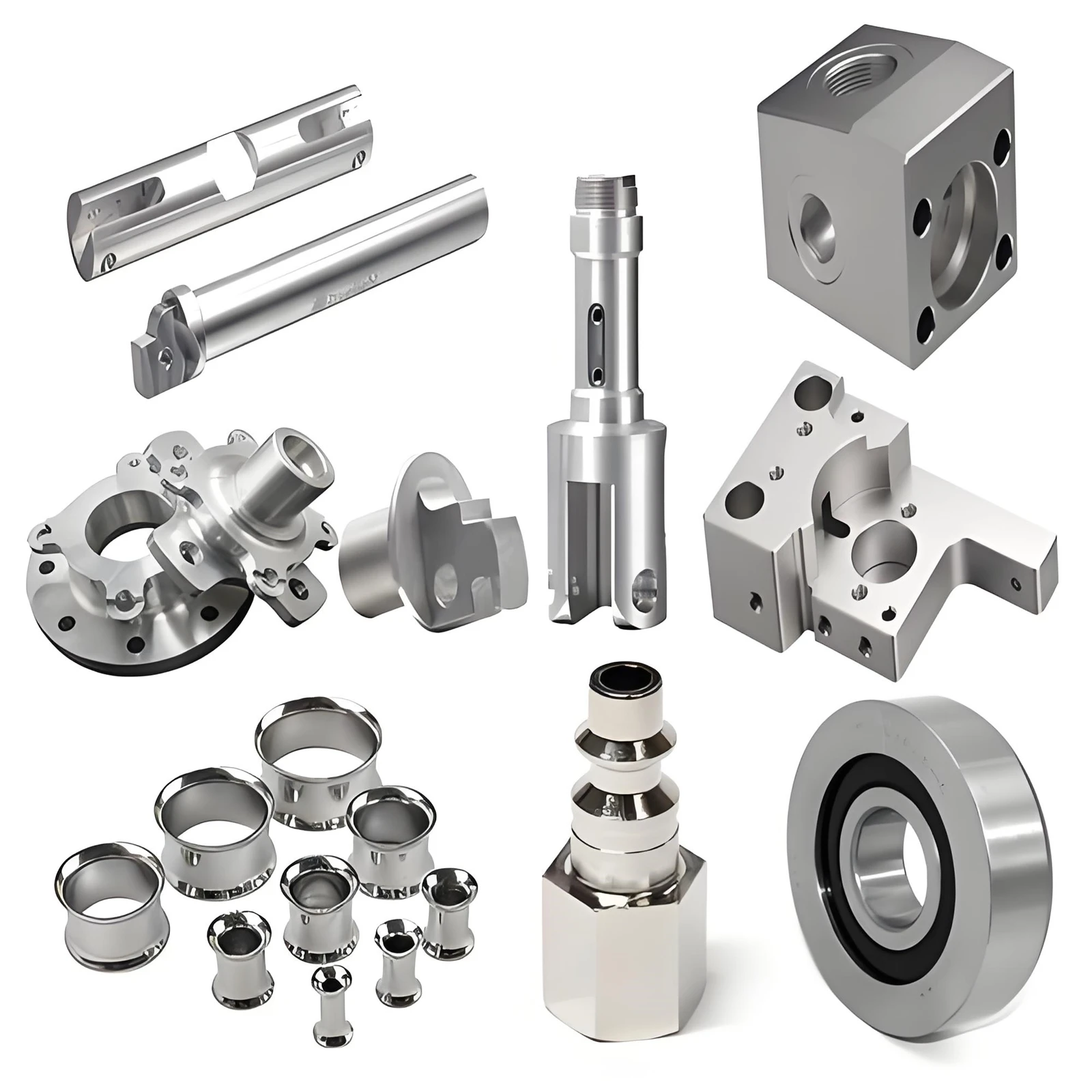
Material decisions. The rule is simple: calculate the load and the weight budget first, then pick the material - never the other way around. Joint housings and arm links need stiffness-to-weight ratio, so 6061 is the default and 7075 handles high-load arms; harmonic drive and gear components need wear-resistant tooth faces, where hardened steel or 17-4PH is the honest answer - aluminum is brittle in front of a gear tooth. End effectors step up to Ti-6Al-4V where loads are heavy; shafts, sleeves, and couplings are rotational and concentric by nature, so stainless or brass turned parts stay truest. Youde's robotics cnc machining material list covers all of this: 6061/7075/5052, 304/316/420 stainless, carbon steel, tool steel, titanium, brass, copper, plus engineering plastics like POM and PEEK.
Tolerances are a budget, not a goal. A robot's repeatability is assembled, not stacked from "tighter is better" parts. Give the critical mating faces - bearing seats, servo interfaces, gear locating faces - ±0.01mm; structural plates and brackets can relax to ±0.05 to 0.1mm and the cost drops immediately. The uncomfortable truth in robotics cnc machining is that maybe 60 percent of a robot's parts don't need tight tolerances, but the five percent that do - the joint mating faces - will scrap a whole assembly if they drift by 0.02. Youde's numbers bracket exactly this range: milling ±0.01 to 0.02mm, turning ±0.005 to 0.01mm, coaxiality 0.005mm.
Process selection is the most underrated step in robotics cnc machining. Five-axis or 4-axis-indexed machining takes a joint housing's angled faces, oblique holes, and internal passages in one setup with angle accuracy at ±0.1°, and clamping error simply disappears; shafts and sleeves go to turn-mill centers with 0.005mm concentricity; micro holes, narrow slits, and hard materials go to EDM and wire EDM, down to a 0.1mm slit; genuinely high-precision faces - guide ways, mating end faces - get ground to ±0.002 to 0.005mm with Ra 0.2. The selection logic isn't "which machine is more expensive," it's "which process is most stable for this feature."
Finishing is a decision too, and it's usually left until the last minute. Joint housing exteriors get anodized - Type II for general duty, Type III hard anodize for wear-resistant assembly interfaces; parts that sit in front of vision systems get black anodize to kill reflection; sandblasting plus anodize is the best cost-to-look ratio; bearing bores get no coating at all, relying on Ra 0.4 surface finish to keep interference fits stable. Anodize thickness runs 10 to 25μm with multiple colors - all standard items in Youde's finishing table.
A few DFM red lines every robotics cnc machining supplier will repeat. Minimum wall thickness 0.5mm - below that, chatter and distortion become the norm in milling. Deep holes top out around a 10:1 depth-to-diameter ratio before you need stepped bores or a different process. Thread depth shouldn't exceed five times the diameter. And the big one: don't mark the whole drawing ±0.01mm. Tolerate only the features that need it and leave the rest at standard values - quoting gets faster, lead times get shorter, and the parts that matter still fit.
The path from prototype to volume is well-defined. A prototype starts at MOQ 1 piece with samples in 3 to 7 working days; small batches of 10 to 100 pieces land in 7 to 15 working days; at production scale, robotics cnc machining is a consistency game - Youde runs 10,000+ pieces monthly capacity with batch consistency held at ±0.01mm, every part backed by CMM full-size inspection, FAI reports, and material certificates under ISO 9001 with IQC/IPQC/OQC control. STEP, IGES, STP, or a raw 3D model gets the job started.
On the supply side, YOUDE PROTOTYPE LIMITED started CNC machining in 2005 and went international in 2009 - robot joints, gearbox housings, end-effector connectors, and sensor brackets have been through their shop for years. Send the 3D model and the load conditions, and they'll tell you where to put the tolerance, how to route the process, and whether to anodize - that's the part of the CNC Machining Robotics Part product page that actually pays off.
One line to keep: robotics cnc machining isn't won by expensive machines - it's four decisions done right: the right material, honest tolerances, matched processes, and finished surfaces that survive the field. Between the first prototype and the ten-thousandth unit, the only difference is process. Not luck.
Robotics CNC Machining: From Prototype Robot Parts To 10,000 Units
Popular Products

Medical Prototype Machining
Medical prototype work sits at a critical point in device development. It is the stage where design intent must become

Medical Device CNC Machining
We supply medical device CNC machining for orthopedic implants, surgical instruments, diagnostic equipment, and
Aircraft CNC Machining Parts
Sourcing aircraft CNC machining parts comes with almost no room for error. A structural bracket out of tolerance by a

Tight Tolerance CNC Machining
Tight tolerance CNC machining delivers the dimensional precision required for the most demanding applications,
Stainless Steel CNC Parts Processing
We deliver high-quality stainless steel CNC parts to manufacturers in electronics, telecommunications, medical devices,

Aerospace CNC Machining Services
Our capabilities cover a wide range of materials including Aluminum (6061, 7075), Titanium (Ti-6Al-4V), Stainless