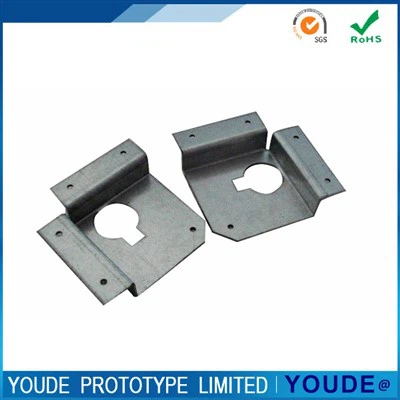

1. The customisation gene of CNC machining: from freedom of design to adaptability of materials
The main idea behind CNC machining is to use computer programmes to control the machine tool's movement, which lets you remove and shape materials with great accuracy. This feature naturally gives it three big benefits for helping with custom production:
A big step forward in design freedom
Mould prices and development periods make it hard to respond quickly to small batches and different types of moulds in traditional mould manufacture. Digital programming makes it easy for CNC machining to address design needs such complicated surfaces and structures that aren't straight. For instance, Porsche's classic models have 52,000 parts, and if any of them are out of stock, they can be customised with CNC machining without having to rebuild the production line. The time it takes to make one item is cut down to a few hours to a few days, and the amount of space needed in the warehouse is cut by more than 60%.
Materials that can be used in many ways
The specific demand for cars includes a wide range of materials, such as metals (aluminium alloys, titanium alloys, and high-strength steel), composite materials (carbon fibre reinforced plastics and glass fibres), and engineering plastics. CNC machining can make precise cuts in diverse materials by using unique equipment and improving the technique.
Aluminium alloy: used to make lightweight wheels that can be customised, to make spokes more streamlined using five-axis linkage processing, and to cut the weight by 30% compared to regular castings;
Carbon fibre composite material: bespoke body panels for high-performance cars, made with low-temperature cutting technology to keep the layers from coming apart, with a surface roughness of Ra ≤ 0.2 μ m;
Titanium alloy: utilised to make racing valve springs fit better, with a micrometer-level of accuracy and five times more resilience to wear and tear thanks to strong alloy-coated cutting tools.
Small batches provide big economic benefits.
When making unique parts with an annual output of less than 10,000 pieces, CNC machining is much cheaper than older methods like die-casting and forging. Taking the personalised electronic control housing of a new energy vehicle company For instance, CNC machining makes it possible to mould the cavities and wiring terminals together. There is no cost for the mould, and the cost of each item is 15% lower than using traditional methods. It also makes it easy to transition from making one component to making a lot of them.
2. Personalised application scenarios: customising anything from the main parts to the full car
CNC machining's capacity to be customised has spread throughout the entire automotive production value chain, affecting three main areas: power systems, body structures, and smart equipment.
Personalising the power system
Engine parts: Rolls Royce makes custom V12 engine piston connecting rods for high-end customers. They use CNC machining to get H7 level tolerance (0 to +0.015mm) for the small end hole diameter of the connecting rod. This makes sure that the connecting rod fits perfectly with the crankshaft and cuts down on vibration noise.
Transmission case: A custom transfer case for off-road vehicles. CNC machining makes sure that the gear chamber and the shifting mechanism chamber are no more than 0.008mm apart, which cuts down on shifting jerkiness by 40%.
The battery pack cooling system: The custom battery housing for new energy cars uses CNC machined aluminium alloy cooling channels that have a channel uniformity error of ≤ 0.05mm. This makes the cooling system 15% more effective and increases the life of the battery by 20%.
Body structure made to order
Lightweight body panel: CNC machining carbon fibre prepreg makes the surface of the body cover accurate to within 0.05 mm, which is three times more efficient than traditional manual layering.
Customised wheel hub: a five-axis CNC machining centre is used to carve the spokes in 3D, which makes the wheels 25% lighter than cast wheels and lets you choose your own pattern.
Components of the suspension system: Customised control arms made with CNC machining achieve clearance control between ball pins and bushings (0.05–0.1 mm), which makes handling more stable.
Personalisation of smart devices
The laser radar bracket for self-driving cars needs to be IP67 waterproof, and CNC machining should make the sealing surface flatness error ≤ 0.02mm;
Wire harness fasteners: Customised nylon wire harness buckles use CNC machining to make complex buckle structures, which speeds up assembly by 50%.
Metal pieces inside: High-end models have bespoke air conditioning outlet blades made of CNC machined aluminium alloy. They have surface anodising treatment and can withstand up to 1000 hours of salt spray testing without corroding.
3. Technology-driven: smart and adaptable upgrades
CNC machining is establishing adaptable intelligent manufacturing capabilities through four significant technology enhancements to meet the challenges of "multiple varieties, small batches, and short delivery times" in custom vehicle production:
Planning Digital Processes
Use CAD/CAM software to automatically create machining paths from 3D models. For instance, Siemens NX software can make tool paths better, save tool travel by 30%, and cut machining time by 20%.
Online detection and control in a closed loop
Real-time processing data is captured and sent to the MES system via laser probes, probes, and other tools. This method has helped one company reach a "zero waste rate" in gearbox housing processing, cutting the time it takes to inspect each piece from 15 minutes to 2 minutes.
Machining composites on several axes
The five-axis linkage machining centre can do a lot of different things, such turning, milling, and drilling, all in one clamping. This cuts down on mistakes that happen when clamping. For instance, the five-axis CNC machine makes the motor housing so that the cavity and the mounting surface are parallel to each other with an error of less than 0.006mm. This cuts motor vibration in half.
AI-enabled adaptive processing
Use machine learning algorithms to automatically change the cutting speed and feed rate based on things like how hard the material is and how worn the tool is. After using this technique in a given business, the tool life was extended by 40%, and the surface roughness of the machined surface stayed stable at Ra ≤ 0.4 μ m.