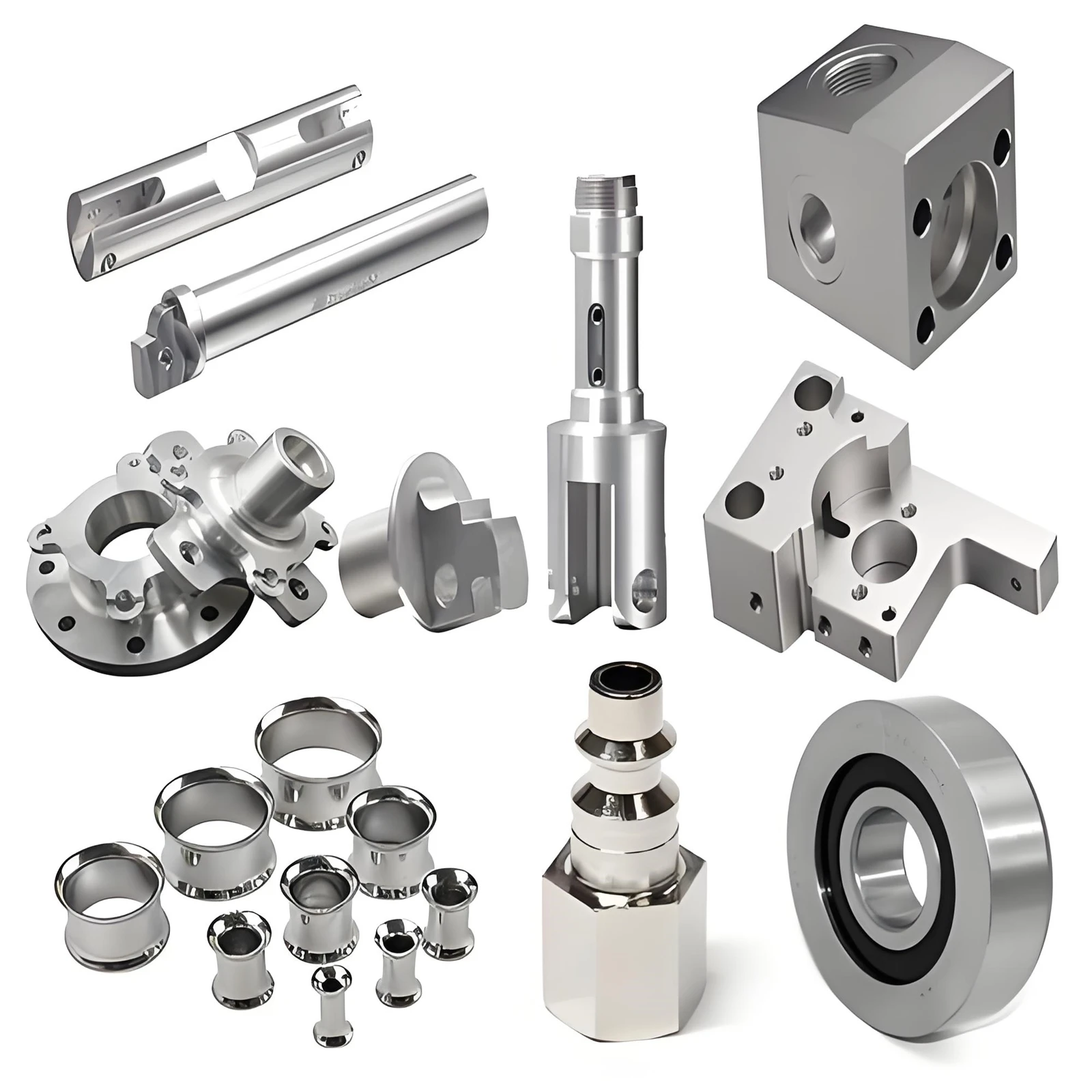

Turning a part from a drawing into a physical component requires much more than simply running a CNC machine.
A metal part that looks relatively simple may include deep pockets, thin walls, threaded holes, precision mating surfaces, and specific finishing requirements. During the prototype stage, you may need only five pieces. A few weeks later, demand may increase quickly to several hundred.
For engineers and procurement teams, the real questions are rarely, "What is CNC machining?" Instead, they are:
Can this part actually be machined? Is the current design suitable for production? Should it be milled or turned? How much will the material, tolerances, and surface finish affect cost? And can the supplier maintain consistent quality when a project moves from prototypes to low-volume production and then to stable manufacturing?
That is where professional CNC services and machining services create real value.
1. CNC Services Are About More Than Cutting Material
The basic principle of CNC machining is straightforward: computer-controlled machine tools and cutting tools remove material along programmed paths to produce parts according to engineering drawings.
A complete machining project, however, involves much more than operating a machine.
A typical project begins with an evaluation of drawings and CAD files. It then moves through process planning, material selection, cutting-tool and fixture planning, CNC programming, milling or turning, dimensional inspection, surface finishing, and final delivery.
When a purchasing team selects a machining supplier, it is selecting an entire manufacturing capability-not simply purchasing a few hours of machine time.
Once a component moves into an assembly, repeatability becomes critical. Producing one acceptable prototype is relatively straightforward. The real challenge is making sure part No. 1, part No. 50, and part No. 500 consistently meet the required specifications.
That consistency is one of the most important considerations when evaluating CNC manufacturing partners for ongoing production.
2. When Do You Need Custom CNC Machining?
Standard components can only solve a limited range of engineering requirements.
When a project involves non-standard dimensions, special geometries, specific materials, or strict mating requirements, custom CNC machining is usually required.
Typical applications include:
Functional prototypes during product development
Mechanical components with non-standard dimensions
Aluminum housings, brackets, and mounting bases
Shafts, sleeves, and other rotational components
Parts with holes, threads, grooves, and complex surfaces
Replacement parts that are no longer commercially available
Custom components transitioning from prototype to low-volume production
The value of custom machining, however, is not simply that a supplier follows whatever appears on the drawing.
An experienced machining supplier should be able to identify manufacturing issues before cutting begins.
For example, standard round cutting tools cannot produce a perfectly sharp internal corner. An excessively deep pocket may require an extended cutting tool, increasing the risk of vibration. Extremely tight tolerances that do not serve a functional purpose may unnecessarily increase both machining and inspection costs.
For this reason, a professional custom CNC service should combine machining capability with DFM-Design for Manufacturability-knowledge.
3. From CAD Files to CNC Machining Parts: What Happens Before Production?
Many of the decisions that determine the final quality and cost of CNC machining parts are made before the first cut is ever made.
Drawing and CAD File Review
The first step is understanding the geometry of the component and its functional requirements.
In addition to reviewing the 3D model, the machinist or engineering team needs to understand:
Which dimensions are critical
Which surfaces must mate with other components
Where tight tolerances are required
Whether the design includes threads, counterbores, deep holes, or chamfers
Surface roughness requirements
Whether additional surface treatment is required
Providing only a 3D model without identifying which dimensions are functionally important can create problems.
The machining supplier may apply the same dimensional standard throughout the part, even where it is unnecessary. That can increase production cost without improving the actual function of the component.
DFM Analysis
The purpose of DFM is to make the component easier, more stable, and more economical to manufacture without changing its intended design function.
Typical DFM checks include:
Whether internal corners can be machined with standard cutting tools
Whether the depth-to-width ratio of deep pockets is reasonable
Whether thin walls may deform during machining
Whether cutting tools can reach all required areas
Whether unnecessarily tight tolerances are specified
Whether thread sizes and hole diameters are compatible with standard tooling
Whether special fixtures or multiple setups will be required
Sometimes, a relatively small design modification can significantly reduce machining difficulty.
That is why DFM is particularly valuable in custom CNC machining projects where geometry, tolerances, and production quantities may still be evolving.
Material Selection
Material selection affects more than the final mechanical performance of a component. It also directly influences machining speed, cutting-tool life, surface quality, and manufacturing cost.
Common materials used in CNC machining include:
Metals
Aluminum alloys
Stainless steel
Carbon steel and alloy steel
Brass
Copper
Titanium alloys
Engineering Plastics
POM / Delrin
ABS
Nylon
PTFE
Acrylic
Polycarbonate
Aluminum alloys offer good machinability and are widely used for rapid prototypes and industrial components.
Stainless steel provides high strength and corrosion resistance but is more difficult to machine.
Certain engineering plastics require additional attention to heat generation and deformation caused by workholding during machining.
Material selection should therefore consider the operating environment, mechanical properties, weight, corrosion resistance, cost, and machinability together rather than evaluating any one factor in isolation.
4. CNC Milling vs. CNC Turning: Which Machining Service Should You Choose?
Different component geometries require different machining processes.
CNC Milling
CNC milling is well suited for components containing:
Flat surfaces
Holes
Slots
Pockets
Steps
Complex 3D surfaces
Typical examples include aluminum housings, mounting brackets, machine bases, equipment panels, structural components, and parts with complex hole patterns.
CNC Turning
CNC turning is generally more suitable for components based primarily on cylindrical geometry.
Examples include:
Shafts
Sleeves
Bushings
Round connectors
Threaded components
Rotating machine parts
Some components combine rotational geometry with milled features and therefore require both turning and milling operations.
According to information published on the Youde website, its machining capabilities include 3-axis machining, 4-axis indexed machining, turning, and milling.
For complex parts, selecting and planning the appropriate machining process is itself an important part of project evaluation.
5. CNC Manufacturing vs. CNC Fabrication: What Is the Difference?
The terms CNC manufacturing and CNC fabrication are often used interchangeably in searches and purchasing discussions, but they do not always describe the same thing.
CNC manufacturing generally refers to a broader manufacturing workflow that may include:
design evaluation → material preparation → CNC machining → inspection → surface finishing → assembly or delivery.
Fabrication is a broader term that, depending on the project, may also include cutting, bending, welding, and sheet metal processing.
If a component is primarily produced by removing material from metal blocks or bars through milling and turning, CNC machining is the more precise description.
If the project also involves sheet metal, cutting, bending, or similar processes, CNC fabrication may be the more appropriate term.
According to the Youde website, its currently listed manufacturing capabilities include CNC machining, rapid CNC machining, 3D printing, vacuum casting, and sheet metal fabrication.
For projects that require multiple manufacturing technologies, the appropriate process can be selected according to the structure and requirements of each component.
6. From Prototype to Production: Priorities Change
The same component may require very different manufacturing priorities at different stages of its lifecycle.
Prototype Stage
During early product validation, the key questions are usually:
Can the component be produced quickly? Are the dimensions correct? Does it assemble properly? Does the material perform as expected? Does the design need to be modified?
At this stage, speed and flexibility matter most.
Low-Volume Production
Once the design is largely finalized but market demand is still uncertain, low-volume CNC production can help avoid investing in dedicated tooling too early.
The focus shifts toward:
Per-part cost
Manufacturing consistency
Flexibility to make design changes
Delivery speed
This is one reason custom machining is frequently used when a product moves from prototype validation toward early commercial production.
Stable Production
When a product enters continuous production, priorities change again.
Manufacturers and purchasing teams need to focus on batch-to-batch consistency, stability of critical dimensions, reliable inspection, sustainable lead times, and opportunities to eliminate unnecessary machining time and cost.
Producing one successful prototype and maintaining stable production are two very different challenges.
A supplier providing long-term machining services should be evaluated accordingly.
7. How to Evaluate a Custom CNC Service Supplier
The lowest quotation does not necessarily result in the lowest total cost.
If dimensional deviations, rework, communication errors, and delivery delays repeatedly occur during production, the resulting cost can greatly exceed the difference between the original quotations.
When evaluating a supplier for CNC services, consider the following factors.
1. Does Its Machining Capability Match Your Part?
Confirm that the supplier has the turning, milling, and multi-axis capabilities required to manufacture the component.
2. Does the Supplier Understand Your Material?
Aluminum, stainless steel, titanium, copper, and engineering plastics behave very differently during machining.
Owning the necessary equipment does not automatically mean a supplier has experience machining a particular material.
3. Does the Supplier Understand Tolerances?
Tighter is not always better.
A capable supplier should distinguish between critical tolerances and general dimensions and explain which requirements significantly increase manufacturing difficulty.
4. Can the Supplier Provide DFM Feedback?
A good manufacturing partner should do more than say, "Yes, we can make it."
It should also be able to explain why a feature may be expensive to produce and whether a more practical manufacturing approach is available.
5. Is There a Stable Inspection Process?
For components that will be produced repeatedly, inspection capability directly affects batch consistency.
6. Can the Supplier Support Both Prototyping and Production?
If one supplier manufactures the prototype and another takes over production, process knowledge and communication must often be rebuilt.
For products intended for long-term production, it is therefore useful to consider production capability during the prototype stage rather than waiting until volume increases.
A qualified custom CNC service provider should be evaluated not just on its ability to make today's sample, but also on whether it can support the project's next manufacturing stage.
8. What Determines the Cost of CNC Machining Parts?
There is no universal price per part for CNC machining.
The major cost factors include:
Material
Part size
Geometric complexity
Machining time
Number of setups
Tolerance requirements
Surface roughness
Quantity
Surface treatment
Inspection requirements
One point procurement teams sometimes overlook is that machining time is not determined entirely by the physical size of a component.
A small component containing several deep holes, thin walls, complex surfaces, and tight tolerances may require more machining time than a much larger but geometrically simple part.
For this reason, the most effective way to reduce cost is not always to search for a cheaper quotation.
Optimizing the design features that increase machining time and manufacturing difficulty can often have a greater impact.
This is especially important when moving CNC machining parts from prototype quantities into repeat production.
9. What to Prepare Before Requesting a CNC Machining Quote
To help a supplier prepare a fast and accurate quotation, provide as much complete project information as possible at the beginning.
Ideally, your RFQ should include:
3D CAD files
2D engineering drawings
Material requirements
Required quantity
Critical tolerances
Surface finishing requirements
Thread specifications
Special inspection requirements
Target lead time
The more complete the information, the smaller the potential gap between the original quotation and the requirements encountered during actual production.
For complex custom CNC machining projects, complete technical documentation also allows the supplier to perform a more meaningful manufacturability review before production begins.
10. Frequently Asked Questions About CNC Services
What Do CNC Services Typically Include?
Depending on the supplier's capabilities, CNC services may include CNC milling, CNC turning, drilling, tapping, precision machining, prototype manufacturing, low-volume production, dimensional inspection, and various post-processing operations.
The exact scope of machining services should therefore be confirmed according to the requirements of each project.
What Is Custom CNC Machining?
Custom CNC machining means manufacturing non-standard components according to a customer's CAD files, engineering drawings, and technical requirements rather than producing standardized parts with fixed specifications.
It is suitable for custom component manufacturing in product development, machinery, automotive applications, robotics, electronics, medical applications, and other fields.
Can CNC Machining Parts Be Completely Identical?
One of the advantages of CNC machining is strong repeatability, but actual dimensions still remain subject to manufacturing tolerances.
The objective should not be "absolute zero error."
Instead, tolerances should be specified according to the functional requirements of the component, and critical dimensions should be continuously inspected during production.
Is Custom Machining Suitable for Low-Volume Production?
Yes.
Unlike injection molding, CNC machining does not require investment in dedicated molds. This makes custom machining suitable for prototypes, product validation, and low- to medium-volume production.
Which Industries Use CNC Machining?
CNC machining is used in aerospace, robotics, new energy, medical equipment, machinery, electronics, consumer products, and other industries.
The Youde website also identifies these areas among the primary application fields for its CNC machining capabilities.
Choosing the Right CNC Manufacturing Partner
CNC machining is not simply the process of turning a CAD file into a metal component.
Drawing evaluation, material selection, machining strategy, workholding, tolerance control, inspection, and post-processing can all affect final quality, cost, and lead time.
For a custom part project, the most valuable supplier is therefore not simply a company that owns CNC machines.
The stronger manufacturing partner is one that can understand the design intent, identify manufacturing risks, and support the project from prototyping through production.
If your 3D CAD files, 2D drawings, material requirements, quantities, and tolerance requirements are already prepared, a manufacturability review and machining quotation are useful steps before formal production begins.
For complex custom CNC machining projects, this early review can identify potential problems before machining starts and help avoid unnecessary modifications and costs later in the project.
Tags: cnc services, machining services, custom cnc machining, custom machining, custom cnc service, cnc manufacturing, cnc fabrication, cnc machining parts