


CNC machining is a technology in which computer-controlled numerical control machine tools perform automated processing of parts and components. Its core lies in using pre-set programs to drive equipment to complete high-precision, high-efficiency material removal or forming operations. Here is a detailed breakdown:
Definition and Working Principle
Computer Numerical Control (CNC): This refers to controlling machine tool movement through computer programming. Unlike traditional manual operation, CNC machining relies on pre-written code (such as G-code) to instruct equipment to perform actions like cutting, drilling, and milling. G-code consists of a series of coordinate commands, feed rates, spindle speed parameters, and other instructions. The machine's control system reads these line by line and converts them into actual motion trajectories for the servo motors, achieving precise relative displacement between the tool and the workpiece.
Automated Workflow: Operators convert design models (such as CAD files) into programs the machine tool can recognize. Once input into the control system, the machine automatically completes the machining process without requiring manual intervention at every step. Throughout this process, the operator's role shifts largely from directly executing machining actions to monitoring and quality oversight - a fundamental change that distinguishes CNC technology from traditional machine tool operation.
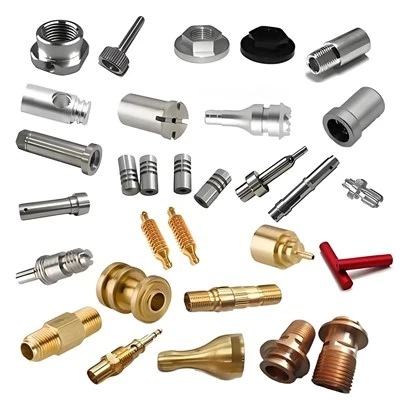
Materials and Scope of Application
CNC technology is applicable to a wide range of materials, including:
Metals: Aluminum alloys, stainless steel, titanium alloys, etc. (used for aerospace and automotive components). Brass and copper alloys are also commonly used for electronic connectors and heat-dissipation components due to their excellent conductivity and machinability.
Plastics: ABS, PC, nylon, etc. (commonly found in consumer electronics housings). Engineering plastics such as POM (polyoxymethylene) and PEEK are also widely used in precision mechanical transmission components due to their high strength and wear resistance.
Wood: Solid wood and composite panels (used for furniture and crafts).
Composite materials: Carbon fiber, fiberglass (used for lightweight structural components). These materials place higher demands on tool wear resistance during cutting, and diamond-coated tools are typically required to extend tool life.
Typical application scenarios: precision mechanical parts, mold manufacturing, prototype development, and customized production. Additionally, with the rise of new energy vehicles and smart wearable devices, demand for CNC machining in emerging fields such as battery structural components and sensor housings is growing rapidly.
Core Purpose: Material Removal and Shape Forming
CNC machining achieves its objectives through subtractive manufacturing:
Removing excess material: Tools such as milling cutters, drills, and lathe tools cut the raw material, progressively shaping the final form.
High-precision forming: Complex geometric structures (such as curved surfaces, threads, and cavities) can be machined, with tolerances typically controlled within a range of ±0.001mm to ±0.1mm. For high-demand fields such as aerospace or medical implants, certain critical dimensions may even need to be controlled at the micron level.
Comparison with traditional methods: Compared to manual operation, CNC eliminates human error, making it especially suitable for maintaining consistency in mass production. CNC machining also offers stronger traceability - the machining parameters for each batch can be recorded and retained, facilitating quality tracing and process optimization.
Evolution of Operating Modes
Traditional approach: Relies on operator skill to control the machine tool, requiring extensive training to achieve precision machining.
Advantages of CNC:
Programmatic control: A single program can be reused repeatedly, reducing dependence on skilled workers.
24-hour operation: Automated production improves efficiency and reduces labor costs. Combined with automatic loading/unloading systems and tool magazine changers, some production lines can even achieve unattended "lights-out" manufacturing.
Complex structure machining: Multi-axis linkage (such as 5-axis machines) is easily achieved, accomplishing three-dimensional curved surfaces that are difficult to process using traditional methods. Five-axis machining is especially suited to parts with complex spatial angles, such as impellers and turbine blades, allowing multiple faces to be machined in a single setup and reducing cumulative error.
Key Technical Requirements
Programming ability: Requires proficiency in CAD/CAM software (such as AutoCAD and Mastercam) to generate toolpaths. Software such as UG (NX), SolidWorks, and PowerMill are also commonly used in the industry for programming and modeling.
Machine tool calibration: Equipment precision must be regularly inspected to ensure accurate positioning of tools and fixtures.
Material adaptation: Cutting parameters (spindle speed, feed rate) must be selected according to the hardness and toughness of the material. The choice of cutting fluid and chip-removal method for different materials also directly affects surface finish quality and tool life.
Quality control: Finished dimensions are inspected using tools such as coordinate measuring machines (CMM). For mass production, SPC (Statistical Process Control) methods are also commonly introduced to monitor fluctuations in key dimensions in real time.
Typical Machining Process
Design stage: Create a 3D model using CAD software.
Programming conversion: Generate machine-executable G-code using CAM software.
Equipment setup: Install tools and fixtures, input the program, and perform a trial run.
Machining execution: The machine automatically completes cutting while the operator monitors the process.
Post-processing: Deburring, polishing, and surface treatment (such as anodizing). Other common surface treatment processes include electroplating, sandblasting, blackening, and PVD coating, with the specific choice depending on the product's functional requirements and appearance standards.
Industry Application Cases
Aerospace: Machining turbine blades and lightweight structural components.
Medical devices: Manufacturing artificial joints and surgical instruments. The medical field has extremely high requirements for material biocompatibility and surface roughness, typically requiring titanium alloys, medical-grade stainless steel, and other special materials combined with ultra-precision machining processes.
Electronics: Producing phone mid-frames and laptop housings.
Automotive industry: Machining engine blocks and transmission gears. With the development of new energy vehicles, demand for CNC machining of lightweight aluminum alloy parts such as motor housings and battery trays continues to rise.
Advantages and Limitations
Advantages:
High precision and high repeatability.
Suitable for small-batch, multi-variety production.
Capable of machining complex shapes that are difficult to achieve with traditional methods.
Limitations:
High equipment costs (5-axis machines can cost several million yuan).
Programming and debugging require specialized technical expertise.
Material waste rate is higher than additive manufacturing (such as 3D printing). As a result, in the design stage, an increasing number of companies are experimenting with "hybrid manufacturing" approaches that combine CNC machining with 3D printing, reducing material loss and production cycles while maintaining precision.
Summary: CNC machining is one of the core technologies of modern manufacturing, achieving efficient and precise material forming through computer control. It is widely applied across every stage from prototype development to large-scale production. Its core value lies in translating design intent into physical products while maintaining quality consistency and production flexibility. As smart manufacturing and Industry 4.0 continue to advance, CNC machining is increasingly integrating with technologies such as the Internet of Things and big data analytics, enabling real-time monitoring of equipment status and intelligent optimization of process parameters - further driving the manufacturing industry toward flexibility and intelligence.


