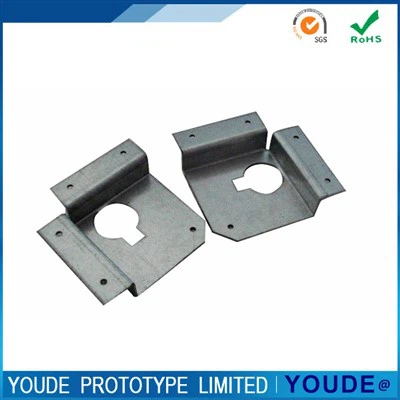

The widespread application of CNC technology and CNC machine tools has brought revolutionary changes to the industrial structure, product types and production methods of the machinery manufacturing industry. As the basis and basis of mechanical processing, the part drawing plays a vital role in CNC machining. Next, let's introduce the analysis of CNC machining parts of typical milled parts. Aluminum alloy metal turning and milling composite parts
1. Analysis of completeness and correctness of parts drawing
Because the processing program is prepared with accurate coordinate points, the view of the parts should be sufficient, correct and clearly expressed, and meet the national standards, and the dimensions and relevant technical requirements should be marked.
2. Analysis of technical requirements of parts
The technical requirements of parts mainly refer to dimensional accuracy, shape accuracy, position accuracy, surface roughness and heat treatment. These requirements should be economical and reasonable under the premise of ensuring the performance of the parts. Too high precision and surface roughness requirements will make the process complicated, difficult to process, and costly.
3. Analysis of dimensioning method
The dimensioning methods on the part drawing include local decentralized labeling method, centralized labeling method and coordinate labeling method. For parts processed on CNC machine tools, the size on the part drawing does not need to be marked with local dispersion on the premise that the processing accuracy can guarantee the use performance, and the centralized label or the same reference label, that is, the coordinate size should be used, so that it is easy to change It is conducive to the unification of design basis, process basis and nominal origin.
4. Technical analysis of parts mechanism
(1) Analyze the deformation of parts to ensure that the required machining accuracy is obtained. Although the machining accuracy of CNC machine tools is very high, for some special cases, the problem is fully paid attention to in the process, and some necessary technological measures should be considered to prevent it. The material of this part belongs to cast aluminum parts, which are not easily deformed, and can meet the requirements. The parts can be annealed to reduce or eliminate the influence of deformation.
(2) Try to unify the relevant dimensions of the arc within the outline of the part. If the contour height of the workpiece to be processed is low and the radius of the transfer arc is large, a milling cutter with a larger diameter can be used for processing, and the number of feeds is reduced accordingly when processing the bottom plate surface, and the surface quality will be better.
5. Positioning benchmark for CNC machining
Pay attention to the following aspects when determining the positioning reference during processing:
(1) A unified reference positioning should be used, and the CNC machining process emphasizes positioning processing. If there is no unified reference positioning, the position and size of the contour on the two surfaces after processing will be inconsistent due to the positioning error caused by the reinstallation of the workpiece. Therefore, in order to ensure the accuracy of the relative position after two clamping processes, a unified reference positioning should be adopted.
(2) The unified datum can be the existing surface on the workpiece, or it can be an auxiliary datum. There is a suitable hole on the workpiece as the positioning datum. If not, the process hole should be specially set as the positioning datum, which is called the auxiliary datum. If there is no suitable auxiliary reference position, you can consider adding a process boss on the blank, making a process hole or setting a process hole on the margin to be processed in the subsequent processing process, and then removing it after completing the positioning process.